As an Amazon Associate, we earn from qualifying purchases. Some links on this site are affiliate links at no extra cost to you. Our recommendations are based on thorough research and editorial judgment.


What Are the Pros and Cons of Solar Generators vs Gas Generators?

I compare solar and gas generators by noting that solar units deliver 0–2 kW continuous, 1–2 kW peak, limited by battery capacity and irradiance, while gas units provide 3–10 kW continuous with 20–30 % surge, maintain voltage under high inrush loads, and run 12–15 hours on gasoline; solar upfront costs range $1,000–$20,000 with a 30 % federal tax credit reducing net expense, whereas gas units cost $500–$5,000 but incur $2–$5 per gallon fuel and regular maintenance; solar operates silently (<30 dB) with zero emissions, gas produces 60–90 dB noise and CO/NOx emissions, solar requires mounting and permitting, gas is plug‑and‑play, and solar’s lifespan extends 10–25 years versus gas engine 5–10 years, so if you continue you’ll discover detailed decision criteria.
Key Takeaways
- Solar generators provide silent (<30 dB), zero‑emission power ideal for indoor use, but their output is limited by battery capacity and sunlight, typically 1–2 kW peak.
- Gas generators deliver higher continuous power (3–10 kW) and handle surge loads, yet they emit CO, NOx, and noise (60–90 dB) and require outdoor operation and fuel storage.
- Solar systems have minimal maintenance and long lifespans (10–25 years for batteries), while gas units need regular spark‑plug, oil, and filter changes and have shorter engine life (5–10 years).
- Upfront cost of solar generators is higher ($1k–$20k) but operating expenses are near zero; gas generators are cheaper initially ($500–$5k) but incur ongoing fuel costs ($2–$5/gal).
- Solar generators are best for low‑power, long‑duration, noise‑sensitive applications; gas generators suit high‑power, short‑duration, or off‑grid scenarios where sunlight is unavailable.
Solar vs Gas: Quick Decision Framework
I’ll start by breaking down the key variables—power output, fuel source, cost, maintenance, environmental impact, and noise/usability—so you can match each factor against your specific needs, then weigh the trade‑offs between solar and gas generators to reach a rapid, data‑driven decision. I compare portable solar units that deliver 1,000‑2,000 W peak, limited by battery capacity and irradiance, with gas generators that sustain 3,000‑10,000 W continuous output, noting surge capability and fuel consumption rates. Emergency compatibility is assessed through runtime per charge versus refuel intervals, while urban portability factors weight, handle design, and silent operation versus 60‑90 dB noise. Grid integration potential is examined via inverter output, AC compatibility, and synchronization protocols, allowing seamless shift between on‑site generation and utility supply.
Solar vs Gas: Power Output & Surge Capability
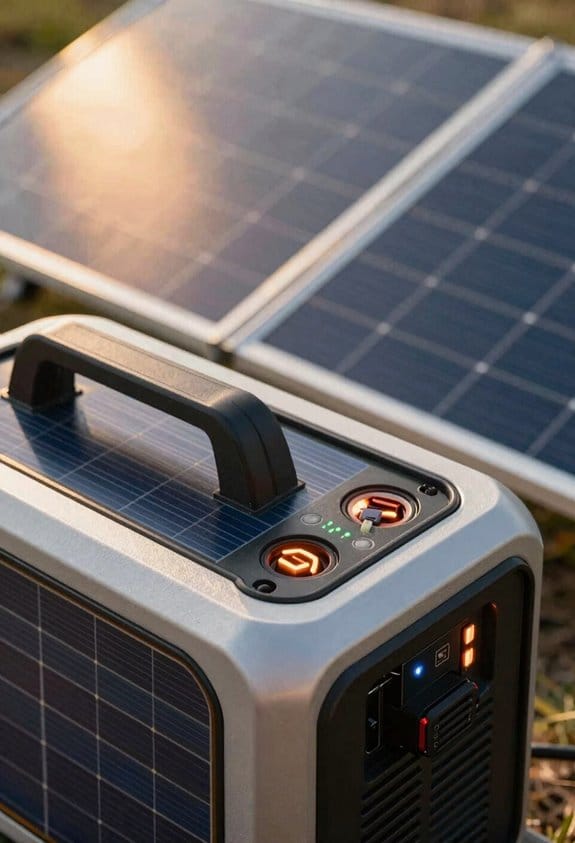
The previous quick‑decision framework highlighted each variable, now the focus shifts to power output and surge capability, where home solar generators and gas generators typically deliver continuous wattage ranging from 3,000 W to 10,000 W, while solar units are limited by battery capacity and inverter rating to peaks of 1,000 W–2,000 W, and can sustain only a fraction of that for extended periods. I note that peak wattage on a solar system is constrained by inverter tech, which caps instantaneous output and reduces surge handling compared with the rapid‑response engine of a gas unit that can accommodate short‑term loads exceeding its continuous rating by 20‑30 %. Startup time for gas models is measured in seconds, whereas solar units require battery charge and inverter initialization, often adding a minute or two before full output is available. This contrast influences suitability for appliances with high inrush currents, such as compressors or power tools, where gas generators maintain stable voltage while solar may dip or shut down if surge handling exceeds design limits.
Solar vs Gas: Long‑Term Fuel Cost Comparison

Because a solar generator’s operating expense is effectively zero once the battery is charged, its long‑term fuel cost is dominated by the initial capital outlay and the amortized price of the photovoltaic array, whereas a gas generator incurs recurring fuel purchases at $2–$5 per gallon, maintenance fees, and depreciation of engine components; consequently, over a ten‑year horizon a 5 kW gas unit consuming 0.5 gal / hour at 50 % load would cost roughly $4,500 in fuel alone, while a comparable 5 kW solar system, after accounting for the 30 % federal tax credit, would have a net expense under $12,000 with negligible ongoing costs, making the per‑kilowatt‑hour cost of solar substantially lower despite higher upfront investment. I note that fuel inflation amplifies gas expenses annually, whereas solar’s negligible operating cost remains stable, and resale value of a well‑maintained solar array can offset initial outlay, further improving its long‑term economic profile.
Solar vs Gas: Maintenance Requirements

Usually, solar generators require minimal upkeep, since their solid‑state battery packs and photovoltaic panels contain no moving parts, yet they still benefit from periodic voltage‑balance checks, inverter firmware updates, and occasional cleaning of solar cells to maintain peak efficiency. I monitor battery health monthly, using a multimeter to verify that voltage stays within the 3.2–3.6 V per cell range, and schedule panel cleaning after dust storms to prevent a 5‑10 % output loss. In contrast, gas units demand regular engine servicing, including spark‑plug inspection, fuel‑filter replacement, and oil replacement every 50–100 hours of operation, which adds labor and parts costs. Both systems require storage‑environment control; however, solar’s lack of combustion components eliminates the need for fuel‑line checks, whereas gas generators must also be inspected for exhaust‑system corrosion and carbon‑deposit buildup.
Recommended Products

Magnificent Performance: Delivering 4085.6 Wh gigantic capacity, Jackery Solar Generator 2000 Plus Kit(4kWh) is capable of powering heavy load devices of up to 3000 W including as air conditioners, RVs, and more meeting all your power needs for outdoor exploration or home use. Additionally, it whispers quiet at just 30dB, when in operation, leaving you complete peace of mind.
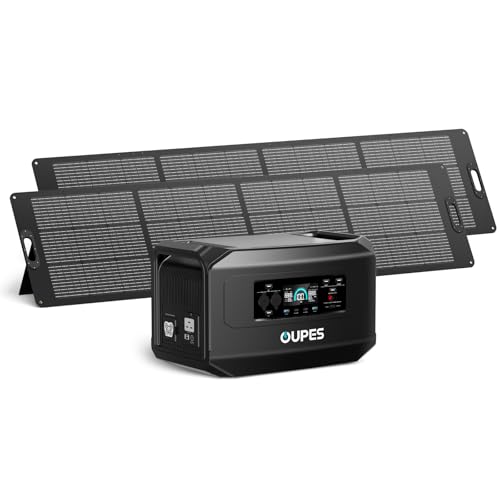
1000W BI-DIRECTIONAL ANDERSON DC PORT – Skip inverter loss with direct 12-80V/30A output. Delivers up to 1000W straight to RV fridges, portable air compressors, trolling motors, and auxiliary battery banks. Also serves as high-speed solar charging input. Perfect for overlanders & boondockers who need efficient, adapter-free DC power routing on the trail.

【Effective Generation】Maximum power generation of 600W of DC power at 12V 24V. Low 4.5mph cut in speed starts charging the battery during calmer winds. At maximum performance, the turbine can generate 50 amps in 12V or 25 amps in 24V.
Solar vs Gas: Environmental Impact & Noise

Maintenance differences aside, environmental impact and noise levels distinguish solar and gas generators, with solar units emitting zero pollutants while gas models release carbon monoxide, nitrogen oxides, and particulates at rates typically ranging from 0.5 g/kWh to 2 g/kWh, and operating at sound pressures of 60–90 dB, compared to the near‑silent (<30 dB) output of inverter‑driven solar systems that can be used indoors without ventilation concerns, although solar performance declines with cloud cover and battery capacity limits, whereas gas generators maintain consistent output regardless of weather but require fuel storage and emit continuous exhaust noise that can exceed residential noise ordinances. I note that urban noise constraints often favor solar because its lifecycle emissions are effectively zero, while gas units contribute measurable emissions throughout production, operation, and disposal. Consequently, the comparative analysis shows solar generators minimizing both ambient sound and cumulative pollutant output, whereas gas generators impose higher acoustic footprints and non‑trivial lifecycle emissions.
Solar vs Gas: Upfront Cost, Tax Credits, and True Investment
If you compare the initial purchase price, a typical portable gas generator costs between $500 and $5,000, whereas a comparable solar generator ranges from $1,000 to $20,000, reflecting the higher expense of battery packs, inverter electronics, and photovoltaic panels, while both categories can include optional accessories such as wheels, handles, and remote monitoring modules that add several hundred dollars to the final invoice. I note that solar systems qualify for a 30 % federal tax credit, which can reduce effective cost to $700–$14,000, whereas gas units receive no comparable incentive, making their net expense lower but fuel‑dependent. Installation logistics for solar involve mounting panels, wiring, and permitting, often extending project timelines, while gas units require simple plug‑and‑play placement, yet both affect resale value; solar generally retains higher resale value due to renewable energy demand, whereas gas resale value depreciates faster because of engine wear and regulatory constraints.
Recommended Products

System Components:Delivers up to 10kW power output with 120V/240V single-phase split-phase support, making it suitable for smoothly running common household appliances. The system includes 18 × 590W solar panels with a total PV capacity of 10620W, capable of generating up to 39.36 kWh per day under optimal conditions, along with two 48V 314Ah portable LiFePO₄ battery offering 32.2 kWh of energy storage. Complete with necessary cables, this all-in-one solar solution is designed for convenient setup and reliable home power support.

System Components:Delivers up to 10kW power output with 120V/240V single-phase split-phase support, making it suitable for smoothly running common household appliances. The system includes 8× 590W solar panels with a total PV capacity of 4,720W, capable of generating up to 19.68 kWh per day under optimal conditions, along with one 48V 314Ah portable LiFePO₄ battery offering 16.1 kWh of energy storage. Complete with necessary cables, this all-in-one solar solution is designed for convenient setup and reliable home power support.

Handles Even the Big Appliances: Run major home appliances with 7200W of rated power (14,400W surge). Supports both 120V and 240V for powerful more devices, even a 5-ton AC for comfortable indoor temperatures or a water heater for a hot shower.
Solar vs Gas: Best Real‑World Use Cases
When evaluating real‑world scenarios, I compare solar generators’ 1,000‑2,000 W continuous output, limited by battery capacity and solar irradiance, to gas generators’ 3,000‑10,000 W surge capability, which depends on engine displacement and fuel flow rate; for off‑grid cabins that require refrigeration, lighting, and occasional power‑tool use, a 2 kW solar system paired with a 1 kWh lithium‑ion pack can sustain 8‑10 hours of operation under full sun, whereas a 5 kW gasoline unit can run 12‑15 hours on a 5‑gallon tank, delivering higher instantaneous power for start‑up loads such as electric heaters or air‑compressors, while the solar option remains silent, emissions‑free, and suitable for indoor use, and the gas option requires ventilation and fuel storage, making it better suited for prolonged outages in regions with limited sunlight or high‑energy demand. For camping backup, remote cabins, off‑grid workshops, and emergency shelters, solar excels when daylight is plentiful and noise must be minimized, whereas gas provides reliable power when fuel logistics are assured and surge capacity is essential.
Recommended Products

[Ideally Output of 9.36KWH] The power of 9.36KWh per day under 4 hours full sunshine by the 2340W solar panel system, very suitable for home, shed, cabin, farm or other energy backup, and it will provide enough power for portable ac, air condition, TV, refrigerator, coffee maker, microwave and other AC 240V (split-phase)devices.

[800W Solar Panel Kit]The 800W off grid solar system complete kit is equipped with 25.2% High-Efficiency Solar Cell 195W bifacial solar panels and 12V 3000W inverter charger for the first time. It not only has higher power generation efficiency, more beautiful all-black appearance, and easier installation, but also uses the UPS power function to provide you with extremely fast conversion power supply of two energy sources. It can not only generate electricity with solar energy, but also charge with mains electricity, allowing you to enjoy your RV trip without worries

Unlock a 30% Tax Credit: You will be eligible to claim a residential clean energy tax credit, on qualified solar electric property. Contact your utility provider, for further information and to confirm specific eligibility and requirements for the Residential Clean Energy Credit Program.
Solar vs Gas: Decision Checklist – Pick the Right Generator
I’ll start by outlining the key criteria—power output, fuel source, cost, maintenance, environmental impact, and noise/usability—so you can match each factor to your specific needs, then weigh the 1,000‑2,000 W continuous rating and 2‑hour battery endurance of solar units against the 3,000‑10,000 W surge capability and 12‑15‑hour runtime of gasoline models, while also considering the upfront price range of $1,000‑$20,000 for solar versus $500‑$5,000 for gas, the 30 % federal tax credit for solar, the $2‑$5 per gallon fuel expense for gas, the 10‑25‑year lifespan of lithium‑ion batteries compared with the 5‑10‑year engine life, the zero‑emission profile and silent operation of solar versus the carbon monoxide, nitrogen oxide, and 60‑90 dB noise output of gas, and finally the indoor‑safe portability of solar against the outdoor‑only requirement and fuel‑storage regulations for gas, enabling a systematic, data‑driven decision. I compare each metric against my usage scenario, noting that battery recycling programs can offset end‑of‑life costs, while installation incentives further reduce net expense, and I document the trade‑offs in a concise checklist that aligns technical specifications with regulatory and environmental constraints.
Frequently Asked Questions
Can Solar Generators Power High‑Wattage Tools Like Saws?
I can power high‑wattage tools if I pair a strong solar array with a big battery, especially for high demand startups using peak shaving strategies, but I’ll need ample sunlight and storage capacity.
Do Gas Generators Work Indoors With Proper Ventilation?
I once watched a kitchen fire spark from a stray exhaust, and I realized gas generators, even with ventilation, still leak carbon monoxide—so indoor safety isn’t guaranteed, and you should never run them inside.
How Long Does a Solar Generator’s Battery Last Before Replacement?
I’ve found the battery typically lasts 5‑10 years before noticeable degradation, though it varies with use; check the warranty terms for exact replacement coverage and any performance guarantees.
What Are the Resale Values of Solar vs. Gas Generators?
I’ve found solar generators retain value longer because retail depreciation is slower, especially as market demand rises for green tech, while gas units drop faster due to fuel‑related wear and shifting preferences.
Can I Combine Solar and Gas Generators for Hybrid Backup?
I’d say yes—by integrating battery management and fuel switching, you can run the solar bank until it depletes, then automatically switch to gas for extended runtime without manual intervention.