As an Amazon Associate, we earn from qualifying purchases. Some links on this site are affiliate links at no extra cost to you. Our recommendations are based on thorough research and editorial judgment.

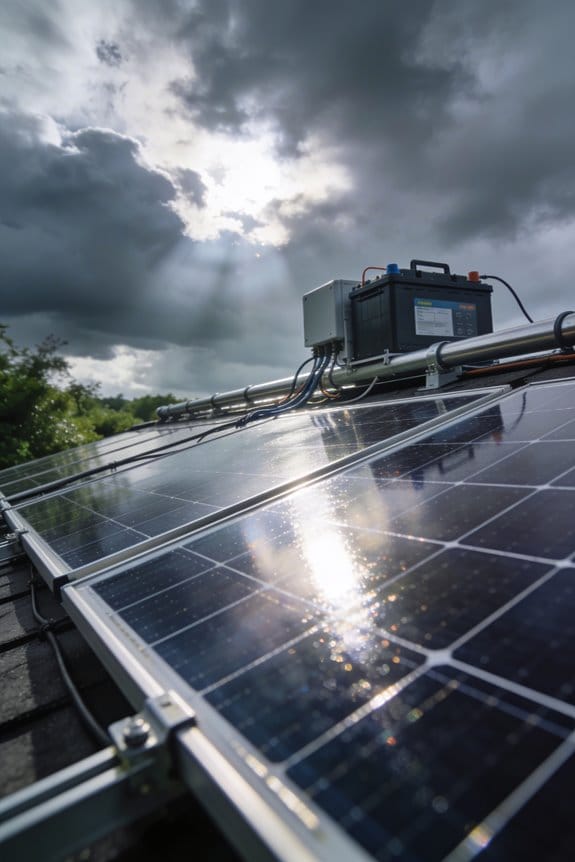
What Happens to Solar Panels on Cloudy Days?

I see that on overcast days a typical 300 W monocrystalline module produces roughly 30–75 W, which is 10–25 % of its rated capacity, because diffuse irradiance falls to about 100–250 W/m² while the silicon spectral response remains unchanged; I note that cooler ambient temperatures raise open‑circuit voltage by approximately 0.05 % per °C, adding 2–3 % efficiency, and that bifacial panels can capture an extra 5–10 % from rear‑side albedo, while MPPT‑enabled inverters keep the cells at their maximum power point, mitigating losses from rapid cloud‑induced irradiance changes, and you’ll find more detailed performance data if you keep exploring.
Key Takeaways
- Solar panel output drops to 10‑25 % of rated capacity under thick cloud cover, producing roughly 0.12‑0.22 kW per kW‑peak installed.
- Diffuse light from clouds reaches cells at many angles; anti‑reflective coatings and bifacial designs capture this scattered irradiance, adding 5‑10 % extra power.
- Cooler ambient temperatures on cloudy days raise open‑circuit voltage (~0.05 % per °C), giving a 2‑3 % efficiency gain despite lower irradiance.
- MPPT‑enabled inverters keep panels operating at their maximum power point, extracting the most energy during rapid irradiance changes.
- Regular cleaning and structural inspections prevent dust, water spots, and misalignment losses that can further reduce already low diffuse‑light output.
How Much Power Do Solar Panels on Cloudy Days Actually Produce?
When cloud cover thickens, the photovoltaic array’s output drops to roughly 10‑25 % of its rated capacity, because diffuse irradiance replaces direct sunlight, yet the panels continue to generate measurable power. I explain that cloud‑to‑ground irradiance, measured in watts per square meter, falls from typical 1000 W/m² under clear skies to 100‑250 W/m² on overcast days, and that the spectral response of silicon cells, peaking near 600 nm, remains largely unchanged, allowing the same bandgap to convert photons despite reduced intensity. In practice, a 5 kW system produces 500‑1250 W during heavy cloud, while light clouds yield 800‑1000 W, and partly cloudy periods can sustain 2500‑3500 W, reflecting the proportional relationship between diffuse flux and rated capacity.
Recommended Products

Specification: 1000-Feet 16AWG*2C, Strand copper, Black, Maximum working voltage: 300V, Great for uses with 30 volts or less

Solar-powered roof and attic ventilation fan for ridge vents

Calculator Set: you will receive rich content of handheld electronic pocket calculators in 6 different colors, such as purple, yellow, blue and more; Sufficient quantity and colors can meet your enough for learning center, tutoring group, office training session, or homeschool setup and a practical homeschool essential
How Do Solar Panels on Cloudy Days Capture Diffuse Light?
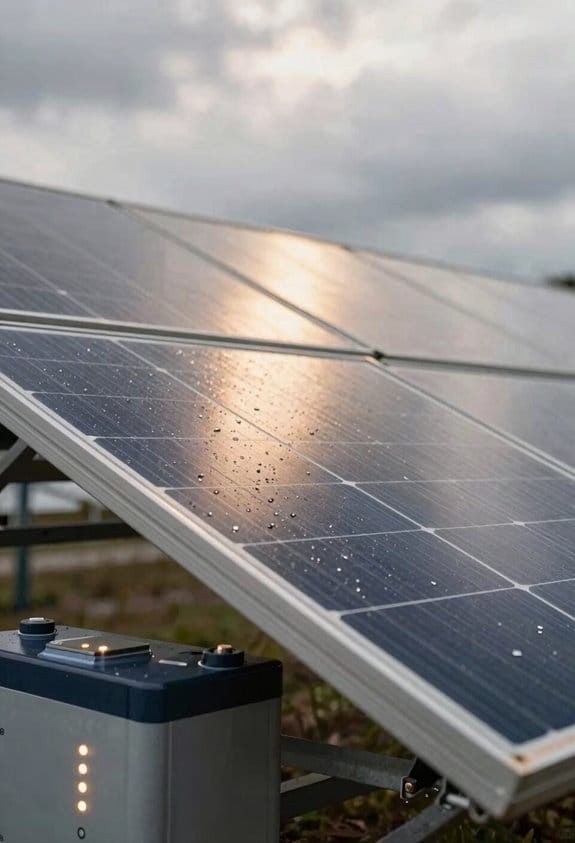
The previous analysis of output percentages under various cloud densities sets the stage for examining how panels actually harvest diffuse illumination—useful context when sizing a home solar power system, because diffuse light, unlike direct sunlight, arrives from a broad solid angle and consequently requires photovoltaic cells to respond to lower irradiance levels while still maintaining spectral compatibility with silicon’s bandgap. I explain that diffuse absorption occurs when photons scattered by cloud droplets strike the cell surface at varied incident angles, enabling charge generation despite reduced intensity. Scattering angles broaden the effective illumination cone, allowing each silicon junction to capture photons from 0‑90°, which maintains a modest current density of 150‑200 A/m² under overcast conditions. Bifacial modules exploit rear‑side scattering, adding roughly 5‑10 % extra power, while anti‑reflective coatings improve angular response, reducing losses caused by oblique incidence.
Why Do Solar Panels on Cloudy Days Perform Better in Cooler Temperatures?
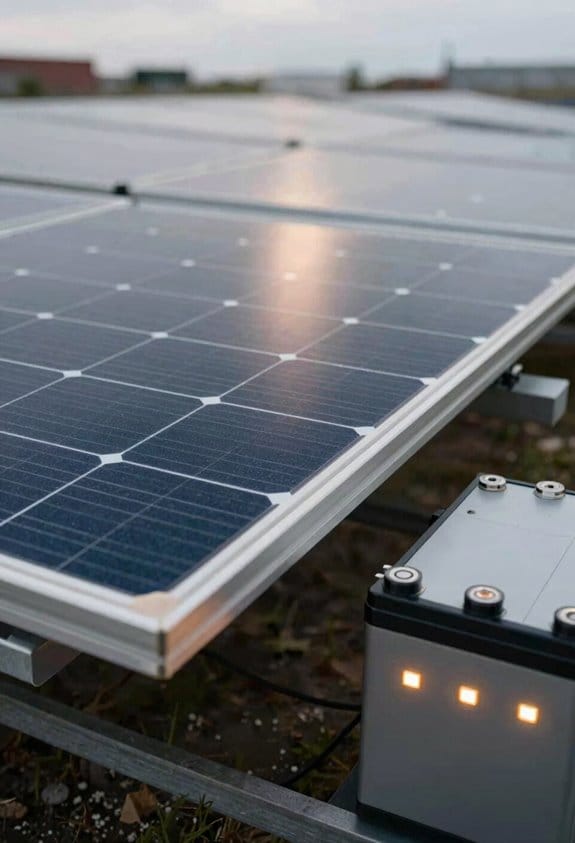
Because semiconductor bandgap energy varies only slightly with temperature, the open‑circuit voltage of a photovoltaic cell rises roughly 0.05 % per degree Celsius decrease, which translates into a 2‑3 % efficiency gain when ambient temperature drops from 30 °C to 15 °C, while the short‑circuit current remains effectively unchanged. I explain that cooler panels maintain lower junction temperatures, reducing carrier recombination rates, and that thermal conductivity of the encapsulant and frame spreads residual heat, preventing hot spots that would otherwise lower voltage. Bandgap shifts caused by temperature decline increase the open‑circuit voltage, while the current stays constant, so overall power output improves despite reduced irradiance. Consequently, on cloudy days, the net efficiency rise can offset part of the diffuse‑light loss, yielding measurable performance benefits.
Real‑World Output Numbers for Solar Panels on Cloudy Days
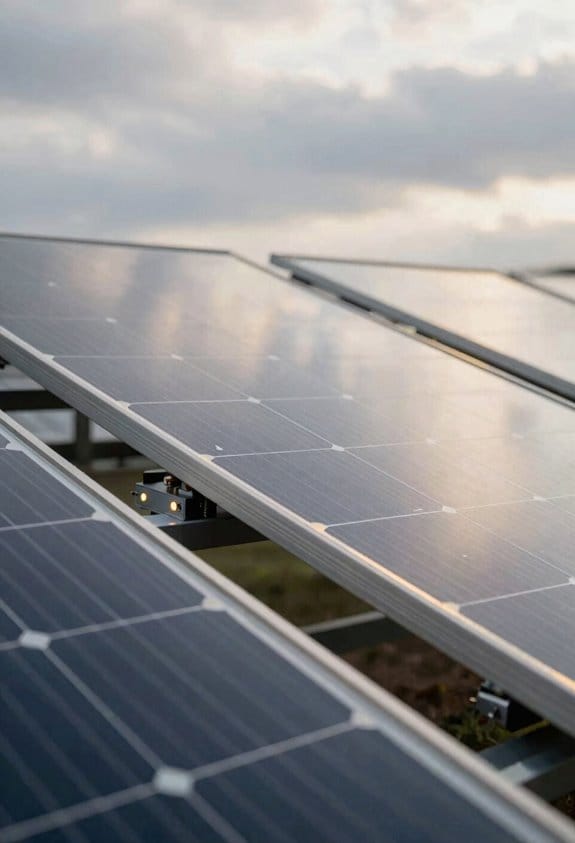
Cooler panel temperatures, which raise open‑circuit voltage by roughly 0.05 % per degree Celsius, help offset diffuse‑light losses, so on a typical overcast day a 300 W monocrystalline module rated at 1000 W/m² delivers about 30–75 W (10–25 % of its rated capacity), while a bifacial panel with 20 % higher albedo capture can reach 36–90 W under the same conditions, and MPPT‑enabled inverters maintain operation at the cell’s maximum power point, ensuring that the system extracts the maximum possible energy despite reduced irradiance, with measured outputs ranging from 0.12 kW to 0.22 kW per kilowatt‑peak installed, depending on cloud thickness, solar angle, and ambient temperature. I observe that cloudy irradiance typically causes panel derating to fall within the 10‑25 % range, meaning a 5 kW array may produce 0.5‑1.25 kW on heavily overcast mornings, while a partly cloudy afternoon can sustain 2‑3 kW, and these figures align with field data collected across mid‑latitude installations.
Best Bifacial & MPPT Solutions for Solar Panels on Cloudy Days
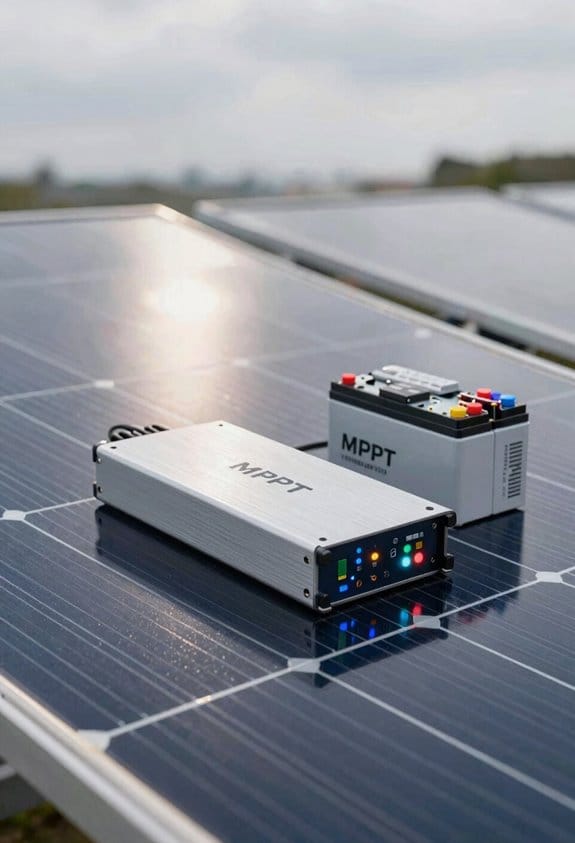
When evaluating bifacial modules for cloudy climates, I compare glass‑glass monocrystalline panels rated at 350 W p‑peak, which typically achieve 12‑18 % higher bifacial gain under diffuse light, with half‑cut designs that reduce series resistance and improve low‑irradiance performance, while simultaneously evaluating MPPT inverters such as the SolarEdge SE7600H‑G3, which supports up to 30 % efficiency improvement through dynamic voltage tracking, and the SMA Sunny Boy 7.0‑E‑TL, which offers a 0.5 % temperature‑compensated voltage boost per degree Celsius below 25 °C, both maintaining operation within 0.12‑22 kW per kW‑p under overcast conditions, and ensuring that the overall system harvests maximum energy despite reduced irradiance and variable cloud deck thickness. I note bifacial benefits increase total output by 5‑10 % on overcast days, while mppt optimization maintains voltage within 0.95‑1.05 × Vmp, reducing loss to under 2 % across rapid cloud shifts.
Maintenance Tips for Solar Panels on Cloudy Days
The bifacial and MPPT performance metrics discussed earlier naturally lead to a focus on maintaining those gains under overcast conditions for rooftop arrays and portable solar panels alike, so I’ll outline how regular cleaning, visual inspections, and temperature monitoring preserve system efficiency. I perform panel cleaning at least monthly, using de‑ionized water and soft brushes to remove dust, pollen, and light residue that can reduce diffuse‑light capture by up to 8 %; on rainy days I still inspect for water‑spot streaks, because mineral deposits may remain after evaporation, affecting bifacial rear‑side irradiance. I conduct mounting inspections quarterly, checking bolts, brackets, and tilt angles for corrosion or loosening, which can alter the cosine‑response and lead to a 3‑5 % loss in energy yield. I also monitor module temperature with infrared sensors, ensuring surface temperature stays below 77 °F (25 °C), because exceeding this threshold reduces voltage by roughly 0.5 % per degree Celsius, compromising overall system performance.
Frequently Asked Questions
Can Solar Panels Still Charge Batteries During Prolonged Overcast Periods?
Imagine a dimmer switch: even under thick clouds, my panels still feed a battery trickle, providing gentle energy buffering that keeps the system alive until the sun returns.
Do Cloud Types (Cumulus vs. Stratus) Affect Panel Output Differently?
I’ve found that cumulus clouds, with their thicker microphysics, usually cut output a bit more than the flatter, more uniform stratification of stratus clouds, so I see slightly higher efficiency on stratus days.
How Does Panel Tilt Angle Influence Diffuse Light Capture on Cloudy Days?
I’ll tell you straight: a steeper tilt boosts diffuse light capture, so aim for the ideal tilt; the angular response improves, letting panels harvest more scattered sunshine on cloudy days.
Will a Solar‑Plus‑Storage System Reduce Reliance on Grid During Cloudy Weather?
I’ll tell you: a solar‑plus‑storage setup can cut grid reliance on cloudy days if you size the battery right and use demand shifting, storing excess daylight power for later use.
Is There a Measurable Difference in Performance Between Monocrystalline and Polycrystalline Panels Under Cloud Cover?
I’d say monocrystalline panels whisper brighter under cloud cover because their broader spectral response captures more diffuse light, and their lower temperature coefficient lets them stay efficient while polycrystalline panels lag slightly.