As an Amazon Associate, we earn from qualifying purchases. Some links on this site are affiliate links at no extra cost to you. Our recommendations are based on thorough research and editorial judgment.


What Is the Difference Between a Battery Bank and a Portable Power Station?

I’m a compact 18 Wh‑185 Wh lithium‑ion pack delivering 5 W‑30 W via USB‑C or USB‑A, while a portable power station ranges from 100 Wh to over 2,000 Wh, supplies 100 W‑several kilowatts through AC inverters, DC car sockets, and high‑power USB‑C ports, and incurs inverter conversion losses of roughly 10‑15 % while supporting surge currents for appliances; the former charges smartphones, tablets, and earbuds, the latter runs laptops, small appliances, and off‑grid tools, and if you continue, you’ll discover more detailed comparisons.
Key Takeaways
- Battery banks are compact, low‑capacity (≈18‑185 Wh) USB‑C/A devices for charging phones and tablets; portable power stations are larger, high‑capacity (≈100‑2000 Wh) units with AC, DC, and multiple USB ports.
- Power stations provide AC outlets and high‑wattage DC ports, enabling operation of laptops, small appliances, and tools; battery banks output only low‑power DC, suitable for personal electronics.
- Stations include inverters with ~10‑15 % conversion loss, while banks deliver direct DC with minimal loss.
- Recharge options differ: stations accept AC wall, solar, and car inputs for fast charging; banks rely on USB chargers, limiting recharge speed.
- Portability and cost trade‑offs: stations weigh 5‑50 lb and cost $100‑$3,000+, whereas banks weigh <1 lb and cost $10‑$100, reflecting their capacity and feature differences.
Portable Power Station vs Power Bank: Battery Capacity & Runtime
Battery capacity defines the fundamental difference between portable power stations and power banks, with stations ranging from 100 Wh to over 2 000 Wh while banks typically span 18 Wh to 185 Wh (or 1 000 – 50 000 mAh at 3.7 V). I note that battery chemistry, usually lithium‑ion or lithium‑polymer, determines energy density and safety, influencing both total Wh and usable runtime; a 500 Wh station, for example, can power a 50 W device for roughly ten hours, whereas a 20 Wh bank might sustain a smartphone for about three hours, assuming similar efficiency. Runtime estimation requires accounting for discharge curves, conversion losses, and device draw, so I calculate expected duration by dividing stored Wh by average power consumption, adjusting for inverter efficiency in stations and direct DC output in banks. This analytical approach clarifies capacity‑runtime relationships across form factors.
Portable Power Station vs Power Bank: Power Output & Device Compatibility

Compare the output specifications of portable power stations and power banks, noting that stations typically deliver 100 W to several kilowatts through AC inverters, DC ports, and multiple USB‑C/A outlets, whereas banks are limited to 10 W–65 W via USB‑C or USB‑A, often lacking AC capability, which means stations can run high‑wattage appliances such as refrigerators, CPAP machines, or power tools for extended periods, while banks suffice for smartphones, tablets, and earbuds, and the presence of an inverter in stations introduces conversion losses of roughly 10 %–15 % that must be accounted for when estimating usable power, whereas banks’ direct DC output incurs minimal loss, resulting in higher efficiency for low‑power devices. I observe that AC compatibility in stations enables Appliance startup for devices requiring surge current, yet the inverter’s efficiency drop must be factored into total energy budgeting, whereas power banks, delivering pure DC, avoid such penalties, making them ideal for continuous low‑draw electronics.
Recommended Products

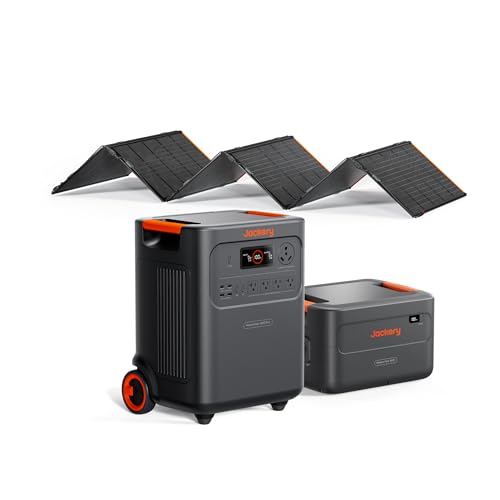
One Powers All. The unit of DELTA Pro Ultra whole house generator includes an inverter and a battery. One inverter supports 120V & 240V and has an exceptional 7200W output, allowing you to run almost any heavy household appliance, even a 3-ton central air conditioner. Triple the inverters for an incredible 21.6kW AC output, allowing you to live life to the fullest even during an outage. The electric generator achieves a total 7200W output even during charging.

Limited-Time Perks:E10 Metal Pad,Up to 12-Month 0% APR
Portable Power Station vs Power Bank: Choosing the Right Ports
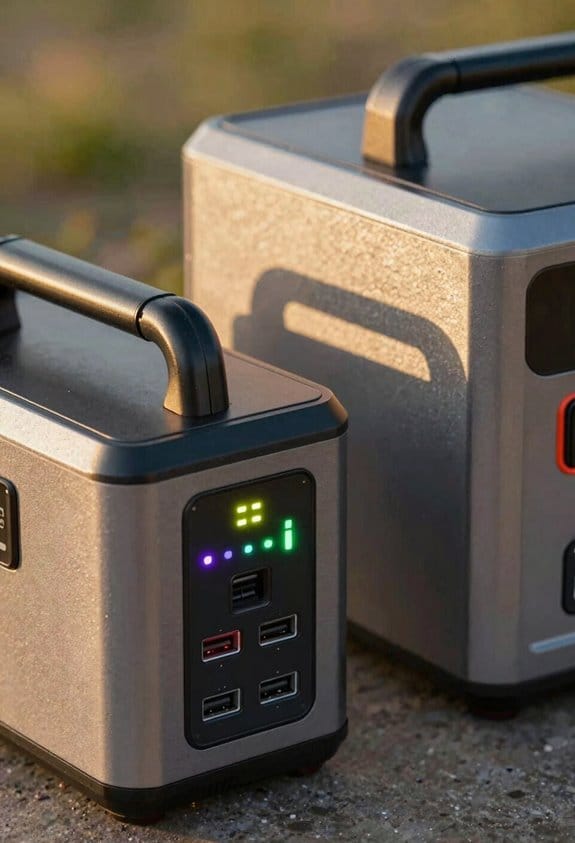
How do you decide which ports matter most when selecting a portable power solution, given that stations typically provide AC outlets ranging from 100 W to several kilowatts, DC car‑cigarette sockets delivering 12 V–24 V at up to 120 A, USB‑C Power‑PD ports supporting 45 W–100 W, and multiple USB‑A ports limited to 5 W–12 W, whereas power banks usually offer only USB‑C DP (15 W–30 W) and USB‑A (5 W–12 W) outputs, often lacking AC or DC options, which means stations can simultaneously power laptops, small appliances, and lighting fixtures, while banks are restricted to charging smartphones, tablets, and wearables; consequently, matching the device’s voltage and current requirements to the available port specifications, accounting for inverter conversion losses of roughly 10 %–15 % on AC outputs and the higher efficiency of direct DC USB‑C charging, becomes essential for ensuring adequate runtime and preventing overload. I evaluate each device’s power envelope, prioritize fast charging USB‑C ports for high‑draw electronics, and employ modular adapters when a station’s DC socket must feed a non‑standard voltage, thereby aligning the load with the most efficient conversion path while avoiding over‑current scenarios.
Recommended Products
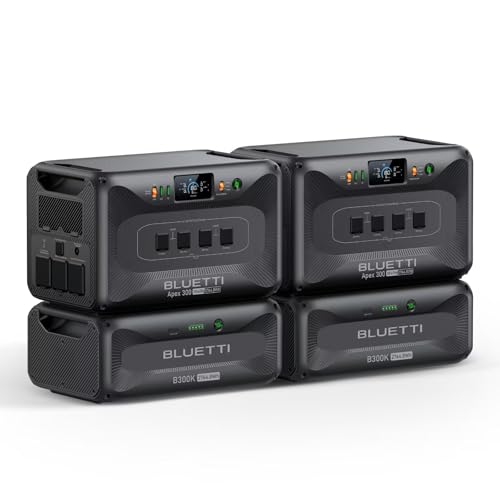
[All-Scenario Power] - Apex 300 (2764.8Wh, 3840W) keeps homes lit, RVs rolling & off-grid sites running. Parallel 2-3 units (5.5-8.3kWh), expand to 58kWh with B300K. Never powerless.

【10.8kWh 6000W High Output, 120V/240V Split Phase Voltage】OSCAL PowerMax 6000 solar generator with 2*extra battery has a capacity of 10.8kWh and provides 4*AC output, 6000W(Surge 9000W), Suports DC/AC Bi-Directional Inverter 120V/240V Dual Voltage Output, ensuring that any appliance can find its match with this device. In the case of an unplanned outage, all the charging outlet demands of the family will be satisfied with its 14 outlet sources. Portable solar power station provides reliable power for your camping trips, outdoor work, or emergency situations.

Handles Even the Big Appliances: Run major home appliances with 7200W of rated power (14,400W surge). Supports both 120V and 240V for powerful more devices, even a 5-ton AC for comfortable indoor temperatures or a water heater for a hot shower.
Portable Power Station vs Power Bank: How to Recharge (Solar, Wall, Car, USB)
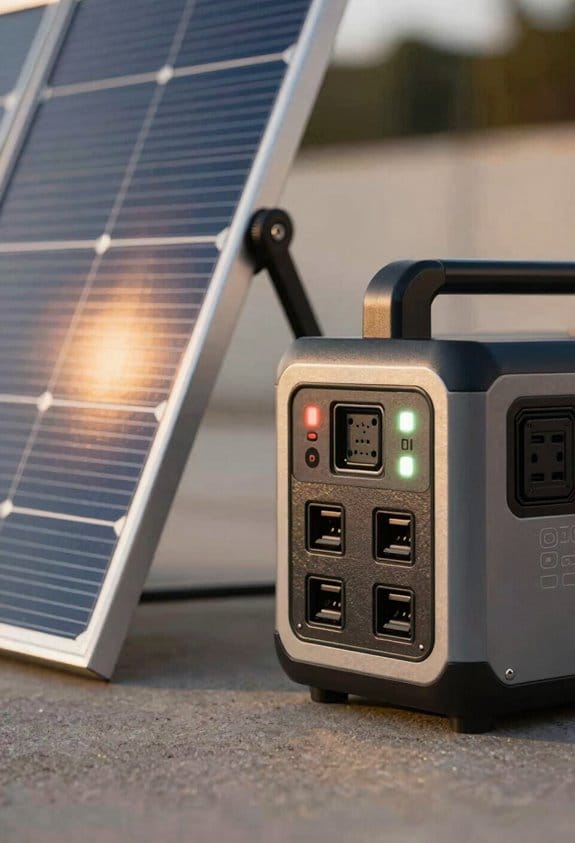
When I compare recharge options, I note that portable power stations accept AC wall input up to 240 V, solar panels rated 100–300 W with MPPT controllers, 12 V car chargers delivering 10–20 A, and optional generator connections, whereas power banks rely solely on USB‑C or micro‑USB adapters providing 5 V–20 V at 2–3 A, limiting recharging speed to roughly 10–30 W; this distinction means stations can replenish 500 Wh capacities in 4–6 hours using a 120 V outlet, while 20 Wh banks require 2–4 hours from a 5 V charger, and solar input can restore 1000Wh units in 8–10 hours under full sun, whereas banks lack solar compatibility entirely. I also find that solar maintenance, such as panel cleaning and MPPT firmware updates, directly influences efficiency, while rapid charging on a wall outlet depends on charger wattage and internal battery chemistry, making the choice of input method critical for achieving advertised charge times.
Recommended Products

Limited-Time Perks: E10 Metal Pad, Up to 12-Month 0% APR

[All-Scenario Power] - Apex 300 (2764.8Wh, 3840W) keeps homes lit, RVs rolling & off-grid sites running. Parallel 2-3 units (5.5-8.3kWh), expand to 58kWh with B300K. Never powerless.

1800W Ultra-Fast Charging - Featuring an advanced 1800W AC fast charging solution, the OUKITEL powerstation can charge from 0% to 80% capacity in an extremely short time, significantly reducing waiting time. Additionally, the powerstation includes a fast/ slow charging selector switch, allowing users to flexibly choose the charging mode based on the capacity of their local power circuit. This ensures both efficient fast charging and safe operation under older wiring or power-limited conditions, preventing overload risks
Portable Power Station vs Power Bank: Portability vs. Size
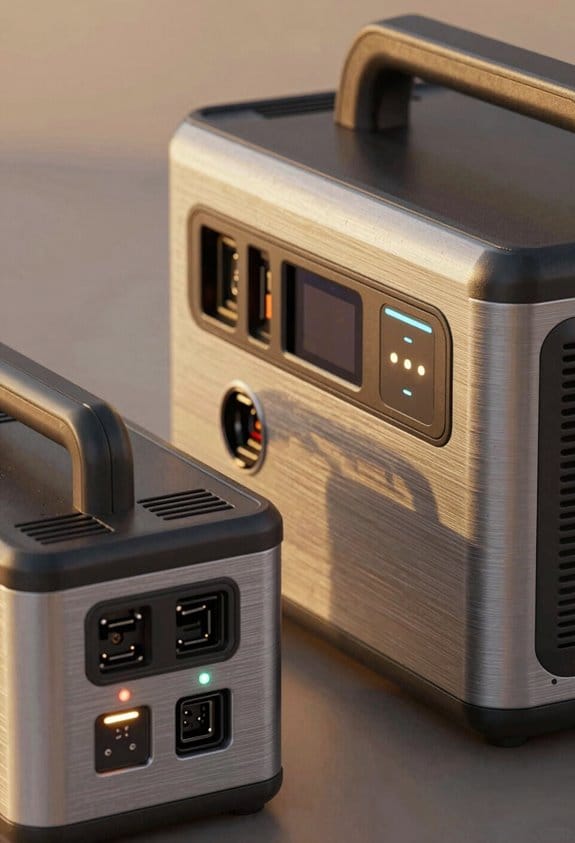
Typically, a portable power station weighs between 5 lb and 50 lb, features a built‑in handle or wheels, and occupies a volume comparable to a small suitcase, whereas a power bank usually ranges from 0.2 lb to 1 lb, fits comfortably in a pocket or backpack, and presents a rectangular form factor no larger than a smartphone. I note that weight tradeoffs become evident when comparing a 500 Wh station, which may approach 20 lb, to a 20 000 mAh power bank, often under 0.5 lb, because the larger battery cells and inverter circuitry increase mass and bulk. Carry convenience, consequently, favors power banks for daily commuting, while stations, despite reduced mobility, deliver sufficient capacity for off‑grid appliances, and their integrated handles or wheels mitigate handling difficulty during transport.
Portable Power Station vs Power Bank: Cost, Lifespan, and Best Use Cases
I often find that the price disparity between portable power stations and power banks directly reflects their differing capacities, charging flexibility, and intended applications, with stations ranging from $100 to $3,000+ for 100 Wh–2,000 Wh units, while power banks cost $10–$100 for 18 Wh–185 Wh models, and this cost gradient correlates with the former’s ability to supply 100 W–several kW via AC inverters versus the latter’s 10 W–65 W USB‑only output, thereby influencing purchase decisions based on budget constraints and required power levels. I note that stations typically offer 5‑year warranty coverage, whereas power banks often provide 1‑year coverage, and the higher replacement cost of a station, sometimes exceeding $300, justifies longer warranty periods; consequently, stations excel in off‑grid camping, emergency backup, and running small appliances, while power banks remain ideal for charging smartphones, tablets, and earbuds during daily commutes.
Recommended Products

【7200Wh 6000W High Output, 120V/240V Split Phase Voltage】OSCAL PowerMax 6000 solar generator with extra battery has a capacity of 7200Wh and provides 4*AC output, 6000W(Surge 9000W), Suports DC/AC Bi-Directional Inverter 120V/240V Dual Voltage Output, ensuring that any appliance can find its match with this device. In the case of an unplanned outage, all the charging outlet demands of the family will be satisfied with its 14 outlet sources. Portable solar power station provides reliable power for your camping trips, outdoor work, or emergency situations.
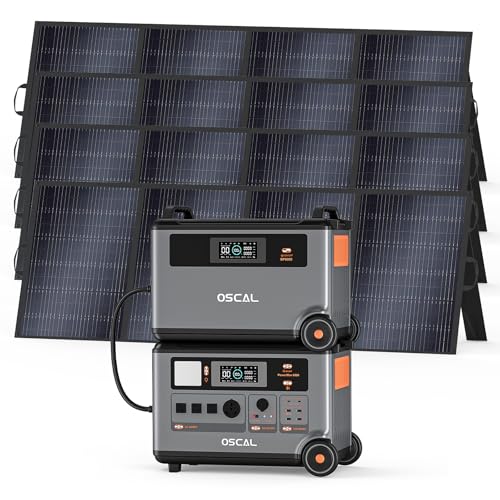
【7200Wh 6000W High Output, 120V/240V Split Phase Voltage】OSCAL PowerMax 6000 solar generator with extra battery has a capacity of 7200Wh and provides 4*AC output, 6000W(Surge 9000W), Suports DC/AC Bi-Directional Inverter 120V/240V Dual Voltage Output, ensuring that any appliance can find its match with this device. In the case of an unplanned outage, all the charging outlet demands of the family will be satisfied with its 14 outlet sources. Portable solar power station provides reliable power for your camping trips, outdoor work, or emergency situations.
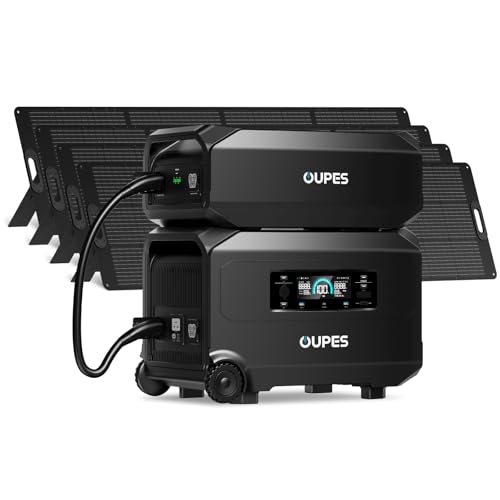
ULTIMATE ENERGY INDEPENDENCE comprehensive system includes Guardian 6000 (4608Wh), one G5 Extra Battery (4608Wh), and four 240W solar panels for complete off-grid capability.
Frequently Asked Questions
Can I Use a Power Bank to Run a Small AC Appliance With an Inverter?
I’d say no—my 10,000 mAh power bank can’t handle a small AC appliance because its 10‑65 W output falls far short of the 100‑W portable inverter you need for AC compatibility.
Do Power Stations Support Fast Charging for Smartphones?
I’ve found that most power stations do support fast charging, phone compatibility, and even wireless charging, adhering to common charging standards like USB‑PD, so your smartphone will charge quickly and safely.
Are There Any Safety Certifications Required for Solar‑Charged Power Stations?
I’ve seen UL, IEC, and CE stickers on my solar‑charged unit; those safety standards mean certification testing is mandatory before I can trust it for off‑grid use.
How Does Temperature Affect the Performance of a Power Bank Versus a Power Station?
I’ve found temperature effects speed up battery aging in power banks more than in stations, because their smaller cells heat faster; stations’ larger, better‑cooled packs tolerate heat, preserving capacity longer.
Can I Connect Multiple Power Stations Together for Higher Capacity?
I’ll say yes, but think of each station as a candle; you can link them in parallel, but only if their interlink compatibility matches, otherwise the flame flickers and the capacity won’t truly add up.